
In linear queues, insertion occurs at the rear end, while deletion happens at the front end.
Ex:
| 10 | 20 | 30 | 40 | 50 |
F=0, R=4
If we want to insert a new element in the queue, it is impossible because the queue is full.
Delete the elements 10 and 20
F=2 R=4
Even though some space is available, we cannot insert a new element because it violates the condition R=MAX-1. This is the major drawback of the linear queue.
To overcome this problem we use the concept of circular queue.
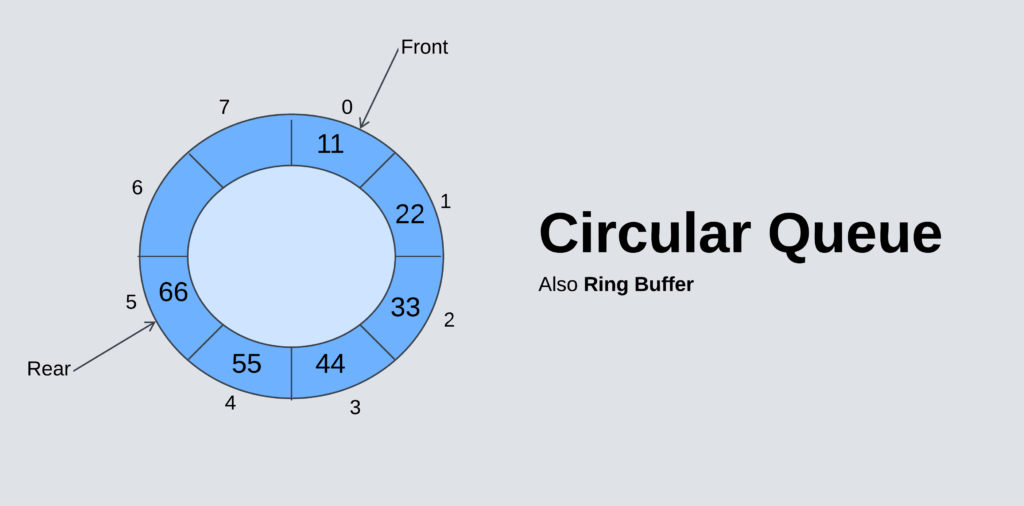
The linear queue in a circle is called a circular queue.
The rules and regulations we apply for queues will also apply to circular queues. In a circular queue, the first index comes right after the last.
Table of Contents
How to Implement a Circular Queue Using an Array:
- Initialize the Circular Queue
- Step 1: Create an array of fixed-size maxSize to hold the queue elements.
- Step 2: Set two pointers, Front and Rear, to indicate the start and end of the queue. Initialize both Front and Rear to -1, indicating an empty queue.
- Check for Queue Overflow
- Step 3: Ensure the queue is not full before inserting an element. This occurs when (Rear + 1) % maxSize == Front. If true, print “Queue Overflow” and stop the insertion process.
- Insert an Element
- Step 4: Update the Rear pointer. If Rear == maxSize – 1, set Rear to 0 (circular wrap-around). Otherwise, increment Rear by 1.
- Step 5: Insert the new item at Q[Rear].
- Step 6: If Front is -1 (the queue was empty), set Front to 0 to mark the queue as not empty.
- Check for Queue Underflow
- Step 7: Check if the queue is empty before deleting an element. This occurs when Front == -1. If true, print “Queue Underflow” and stop the deletion process.
- Delete an Element
- Step 8: Store the item at Q[Front] to be returned.
- Step 9: Update the Front pointer. If Front == Rear, reset both Front and Rear to -1 (the queue is empty).
- Step 10: If Front == maxSize – 1, set Front to 0 (circular wrap-around). Otherwise, increment Front by 1.
- Return the Deleted Element
- Step 11: Return the item stored from the front of the queue.
Insertion into a Circular Queue Algorithm:
CQueueInsertion(Q, maxSize, Front, Rear, item)
Step 1:
- If Rear == maxSize – 1, then
- Set Rear = 0
- Else,
- Increment Rear by 1 (Rear = Rear + 1)
Step 2:
- If Front == Rear, then
- Print “Queue Overflow”
- Return
Step 3:
- Set Q[Rear] = item
Step 4:
- If Front == 0, then
- Set Front = 1
Step 5:
- Return
Deletion from Circular Queue Algorithm:
CQueueDeletion(Q,maxSize,Front,Rear,item)
Step 1:
- Check for Queue Underflow:
- If Front == 0, then
- Print “Queue Underflow”
- Return
(If the front index is 0, the queue is empty and there’s nothing to delete.)
- If Front == 0, then
Step 2:
- Store the Front Item:
- Set K = Q[Front]
(Retrieve the item at the front of the queue.)
- Set K = Q[Front]
Step 3:
- Check if the Queue is Now Empty:
- If Front == Rear, then
- Begin
- Set Front = -1
- Set Rear = -1
- End
(If front equals rear, this is the last item in the queue, so we reset both front and rear to -1, indicating the queue is now empty.)
- Begin
- If Front == Rear, then
- Else:
- Update Front for Circular Movement:
- If Front == maxSize – 1, then
- Set Front = 0
(If the front is at the last position in the array, move it to the beginning, maintaining the circular nature of the queue.)
- Set Front = 0
- Else
- Set Front = Front + 1
(If not, advance the front pointer to the next position.)
- Set Front = Front + 1
- If Front == maxSize – 1, then
- Update Front for Circular Movement:
Step 4:
- Return the Deleted Item:
- Return K
(The queue removes and returns the front element.)
- Return K
Program Implementation of a Circular Queue:
class CircularQueue:
    def __init__(self, size):
        self.size = size  # Maximum size of the queue
        self.queue = [None] * size  # Initialize the queue with None values
        self.front = self.rear = -1  # Initialize front and rear pointers to -1
    def is_empty(self):
        # Check if the queue is empty
        return self.front == -1
    def is_full(self):
        # Check if the queue is full
        return (self.rear + 1) % self.size == self.front
    def enqueue(self, data):
        # Function to insert an element to the queue
        if self.is_full():
            print("Queue is full!")
            return
        if self.front == -1:
            # If the queue is empty, set front to 0
            self.front = 0
        self.rear = (self.rear + 1) % self.size  # Move rear pointer circularly
        self.queue[self.rear] = data  # Insert data at the rear
    def dequeue(self):
        # Function to delete an element from the queue
        if self.is_empty():
            print("Queue is empty!")
            return
        data = self.queue[self.front]
        if self.front == self.rear:
            # If only one element is present, reset front and rear
            self.front = self.rear = -1
        else:
            self.front = (self.front + 1) % self.size  # Move front pointer circularly
        return data  # Return the deleted element
    def print_queue(self):
        # Function to print the elements of the queue
        if self.is_empty():
            print("Queue is empty!")
            return
        if self.rear >= self.front:
            # Print elements from front to rear if rear is ahead
            for i in range(self.front, self.rear + 1):
                print(self.queue[i], end=" ")
            print()
        else:
            # Print elements from front to the end of the array
            for i in range(self.front, self.size):
                print(self.queue[i], end=" ")
            # Print elements from the beginning of the array to rear
            for i in range(0, self.rear + 1):
                print(self.queue[i], end=" ")
            print()
# Example usage
queue = CircularQueue(5)
queue.enqueue(1)
queue.enqueue(2)
queue.enqueue(3)
queue.enqueue(4)
queue.enqueue(5)
print("Queue:")
queue.print_queue()  # Output: 1 2 3 4 5
queue.dequeue()
queue.dequeue()
print("Queue after two dequeues:")
queue.print_queue()  # Output: 3 4 5
queue.enqueue(6)
queue.enqueue(7)
print("Queue after two enqueues:")
queue.print_queue()  # Output: 3 4 5 6 7
#include <iostream>
using namespace std;
class CircularQueue {
private:
int size; // Maximum size of the queue
int *queue; // Array to store queue elements
int front; // Index of the front element
int rear; // Index of the rear element
public:
// Constructor
CircularQueue(int queueSize) : size(queueSize), front(-1), rear(-1) {
queue = new int[size]; // Allocate memory for the queue array
}
// Destructor to free allocated memory
~CircularQueue() {
delete[] queue;
}
// Check if the queue is empty
bool isEmpty() {
return (front == -1);
}
// Check if the queue is full
bool isFull() {
return ((rear + 1) % size == front);
}
// Enqueue operation: Insert an element at the rear
void enqueue(int value) {
if (isFull()) {
cout << "Queue Overflow\n";
} else {
if (isEmpty()) {
front = rear = 0; // Set both front and rear to 0 if the queue is empty
} else {
rear = (rear + 1) % size; // Move rear pointer circularly
}
queue[rear] = value; // Insert the value at the rear
cout << "Inserted " << value << " into the queue.\n";
}
}
// Dequeue operation: Remove an element from the front
int dequeue() {
int value;
if (isEmpty()) {
cout << "Queue Underflow\n";
return -1; // Return -1 to indicate underflow
} else {
value = queue[front];
if (front == rear) { // If only one element is present
front = rear = -1; // Reset front and rear
} else {
front = (front + 1) % size; // Move front pointer circularly
}
return value;
}
}
// Function to display the elements of the queue
void display() {
if (isEmpty()) {
cout << "Queue is Empty\n";
return;
}
cout << "Elements in Circular Queue are: ";
int i = front;
do {
cout << queue[i] << " ";
i = (i + 1) % size;
} while (i != (rear + 1) % size);
cout << endl;
}
};
int main() {
CircularQueue q(5); // Create a circular queue of size 5
q.enqueue(1);
q.enqueue(2);
q.enqueue(3);
q.enqueue(4);
q.enqueue(5); // Queue is now full: 1 2 3 4 5
cout << "Queue: ";
q.display(); // Output: 1 2 3 4 5
q.dequeue();
q.dequeue(); // Two elements dequeued
cout << "Queue after two dequeues: ";
q.display(); // Output: 3 4 5
q.enqueue(6);
q.enqueue(7); // Two elements enqueued
cout << "Queue after two enqueues: ";
q.display(); // Output: 3 4 5 6 7
return 0;
}class CircularQueue {
private int size; // Maximum size of the queue
private int[] queue; // Array to store queue elements
private int front; // Index of the front element
private int rear; // Index of the rear element
// Constructor
public CircularQueue(int queueSize) {
this.size = queueSize;
this.queue = new int[size];
this.front = -1;
this.rear = -1;
}
// Check if the queue is empty
public boolean isEmpty() {
return (front == -1);
}
// Check if the queue is full
public boolean isFull() {
return ((rear + 1) % size == front);
}
// Enqueue operation: Insert an element at the rear
public void enqueue(int value) {
if (isFull()) {
System.out.println("Queue Overflow");
} else {
if (isEmpty()) {
front = rear = 0; // If the queue is empty, set both front and rear to 0
} else {
rear = (rear + 1) % size; // Move rear pointer circularly
}
queue[rear] = value; // Insert the value at the rear
System.out.println("Inserted " + value + " into the queue.");
}
}
// Dequeue operation: Remove an element from the front
public int dequeue() {
int value;
if (isEmpty()) {
System.out.println("Queue Underflow");
return -1; // Return -1 to indicate underflow
} else {
value = queue[front];
if (front == rear) { // If only one element is present
front = rear = -1; // Reset front and rear
} else {
front = (front + 1) % size; // Move front pointer circularly
}
return value;
}
}
// Function to display the elements of the queue
public void display() {
if (isEmpty()) {
System.out.println("Queue is Empty");
return;
}
System.out.print("Elements in Circular Queue are: ");
int i = front;
do {
System.out.print(queue[i] + " ");
i = (i + 1) % size;
} while (i != (rear + 1) % size);
System.out.println();
}
public static void main(String[] args) {
CircularQueue q = new CircularQueue(5); // Create a circular queue of size 5
q.enqueue(1);
q.enqueue(2);
q.enqueue(3);
q.enqueue(4);
q.enqueue(5); // Queue is now full: 1 2 3 4 5
System.out.println("Queue:");
q.display(); // Output: 1 2 3 4 5
q.dequeue();
q.dequeue(); // Two elements dequeued
System.out.println("Queue after two dequeues:");
q.display(); // Output: 3 4 5
q.enqueue(6);
q.enqueue(7); // Two elements enqueued
System.out.println("Queue after two enqueues:");
q.display(); // Output: 3 4 5 6 7
}
}#include <stdio.h>
#include <stdlib.h>
#define SIZE 5 // Define the maximum size of the queue
// Structure to represent a circular queue
typedef struct {
int items[SIZE]; // Array to store queue elements
int front; // Index of the front element
int rear; // Index of the rear element
} CircularQueue;
// Function to initialize the circular queue
void initializeQueue(CircularQueue *q) {
q->front = -1;
q->rear = -1;
}
// Function to check if the queue is empty
int isEmpty(CircularQueue *q) {
return (q->front == -1);
}
// Function to check if the queue is full
int isFull(CircularQueue *q) {
return ((q->rear + 1) % SIZE == q->front);
}
// Function to enqueue (insert) an element into the queue
void enqueue(CircularQueue *q, int value) {
if (isFull(q)) {
printf("Queue Overflow\n");
} else {
if (isEmpty(q)) {
q->front = 0; // If the queue is empty, set front to 0
}
q->rear = (q->rear + 1) % SIZE; // Move rear pointer circularly
q->items[q->rear] = value; // Insert the value at the rear
printf("Inserted %d into the queue.\n", value);
}
}
// Function to dequeue (remove) an element from the queue
int dequeue(CircularQueue *q) {
int value;
if (isEmpty(q)) {
printf("Queue Underflow\n");
return -1; // Return -1 to indicate underflow
} else {
value = q->items[q->front];
if (q->front == q->rear) {
q->front = q->rear = -1; // Reset front and rear if only one element was present
} else {
q->front = (q->front + 1) % SIZE; // Move front pointer circularly
}
return value;
}
}
// Function to display the elements of the queue
void display(CircularQueue *q) {
if (isEmpty(q)) {
printf("Queue is Empty\n");
} else {
int i = q->front;
printf("Elements in Circular Queue are: ");
do {
printf("%d ", q->items[i]);
i = (i + 1) % SIZE;
} while (i != (q->rear + 1) % SIZE); // Loop until the rear is reached
printf("\n");
}
}
int main() {
CircularQueue q;
initializeQueue(&q); // Initialize the queue
enqueue(&q, 1);
enqueue(&q, 2);
enqueue(&q, 3);
enqueue(&q, 4);
enqueue(&q, 5); // Queue is now full: 1 2 3 4 5
printf("Queue: ");
display(&q); // Output: 1 2 3 4 5
dequeue(&q);
dequeue(&q); // Two elements dequeued
printf("Queue after two dequeues: ");
display(&q); // Output: 3 4 5
enqueue(&q, 6);
enqueue(&q, 7); // Two elements enqueued
printf("Queue after two enqueues: ");
display(&q); // Output: 3 4 5 6 7
return 0;
}Output:
Inserted 1 into the queue.
Inserted 2 into the queue.
Inserted 3 into the queue.
Inserted 4 into the queue.
Inserted 5 into the queue.
Queue: Elements in Circular Queue are: 1 2 3 4 5
Queue after two dequeues: Elements in Circular Queue are: 3 4 5
Inserted 6 into the queue.
Inserted 7 into the queue.
Queue after two enqueues: Elements in Circular Queue are: 3 4 5 6 7
Complexity Analysis of Circular Queue Using Array
| Operation | Time Complexity (Average) | Time Complexity (Worst) | Space Complexity |
| Insertion (Enqueue) | O(1) | O(1) | – |
| Deletion (Dequeue) | O(1) | O(1) | – |
| IsEmpty() | O(1) | O(1) | – |
| IsFull() | O(1) | O(1) | – |
| Space Used | – | – | O(n) |
Applications of Circular Queues:
- CPU Scheduling: Circular queues enable fair and efficient allocation of CPU time to multiple processes, preventing any single process from monopolizing resources.
- Data Buffering: Circular queues function as temporary data holders in streaming services and multimedia applications, ensuring smooth and uninterrupted playback.
- Keyboard Buffering: When typing speed exceeds processing speed, circular queues store keystrokes, preventing loss and ensuring they are processed in the correct order.
- Memory Management: Certain memory allocation strategies utilize circular queues to efficiently manage free memory blocks, optimizing allocation and deallocation processes.
- Network Packet Handling: Routers frequently use circular queues to handle incoming data packets, ensuring fair and efficient processing and transmission across networks.
Related FAQs
What is a Circular Queue?
A circular queue is a variation of a regular queue where the last element points back to the beginning, allowing for efficient use of space.
How is a Circular Queue Implemented?
Circular queues are typically implemented using an array, with front and rear pointers managing the queue’s head and tail.
What are the Advantages of a Circular Queue?
Circular queues offer efficient memory usage and prevent overflow if implemented correctly.
When to Use a Circular Queue?
Use circular queues for CPU scheduling, buffering data streams, or managing circular buffers.
How do you know if a circular queue is full or empty?
Check for fullness by comparing rear and front indices, accounting for circularity.